
As a fully accredited faculty of the University, the Distance Learning Institute delivers flexible, online programs that adapt to your schedule not the other way around
The Distance Learning Institute (DLI) is the organ of the University that operates and coordinates the Open and Distance Learning programmes. It has an enhanced status as that of a faculty in the University. It has its own Management Board and an Academic Board. It is empowered to formulate its own policies, employ its own staff and be responsible for academic programmes, examinations, supervise its day-to-day affairs and generate funds for its operations.
Learn more →We offer a diverse selection of accredited degree programs in fields such as Business, Education, Economics and Public Administration. Our flexible programs range from 2 to 5 years, designed to fit your life and help you achieve your career goals.
Discover the strength behind our numbers — from thousands of enrolled students to decades of academic excellence, dedicated faculty, and a growing community of accomplished graduates.
71,061+
Students Enrolled
Dear Learners, Facilitators, E-tutors and Visitors, It is my pleasure to welcome you to the Distance Learning Institute (DLI), University Lagos; a hub of open, flexible, and high-quality education that meets the evolving needs of learners in Nigeria and beyond.
Know more →1,311
Full Time and Adjuncts
48
Years of Experience
11k+
Students Graduated since 2014
From admission to graduation, discover what each stage of your academic journey at UNILAG DLI looks like. We’ve outlined the full student life cycle—so you know exactly what to expect, and how we support you every step of the way.
Explore the Student Life Cycle →Join our LMS
Unlock a world of online learning opportunities with the UNILAG DLI Learning Management System (LMS). Here, you'll find all your course materials, assignments, and communication tools conveniently accessible in one place.
Open LMS →Start your intellectual journey led by our distinguished faculties, where knowledge meets inspiration. Each faculty is a beacon of expertise, collectively shaping an environment of unparalleled academic distinction.
Start your intellectual journey led by our distinguished faculties, where knowledge meets inspiration. Each faculty is a beacon of expertise, collectively shaping an environment of unparalleled academic distinction.
Take the first step toward earning a degree that fits your life. Our simple online application process makes it easy to begin your journey with UNILAG DLI from anywhere, at any time.
Apply now →UNILAG DLI answers your most searched questions.
DLI traces its roots to the 1973/74 session, when the Correspondence and Open Studies Unit (COSU) was set up within UNILAG’s Continuing Education Centre. It has been known as the Distance Learning Institute since December 1997.
When UNILAG was established in 1962, part of its mandate was to offer part-time study in fields such as Business, Accounting, Law and Education through correspondence and distance learning. COSU was created to deliver this. It became autonomous in 1980, was upgraded to the Correspondence and Open Studies Institute (COSIT) in 1983, and was restructured and renamed the Distance Learning Institute in 1997.
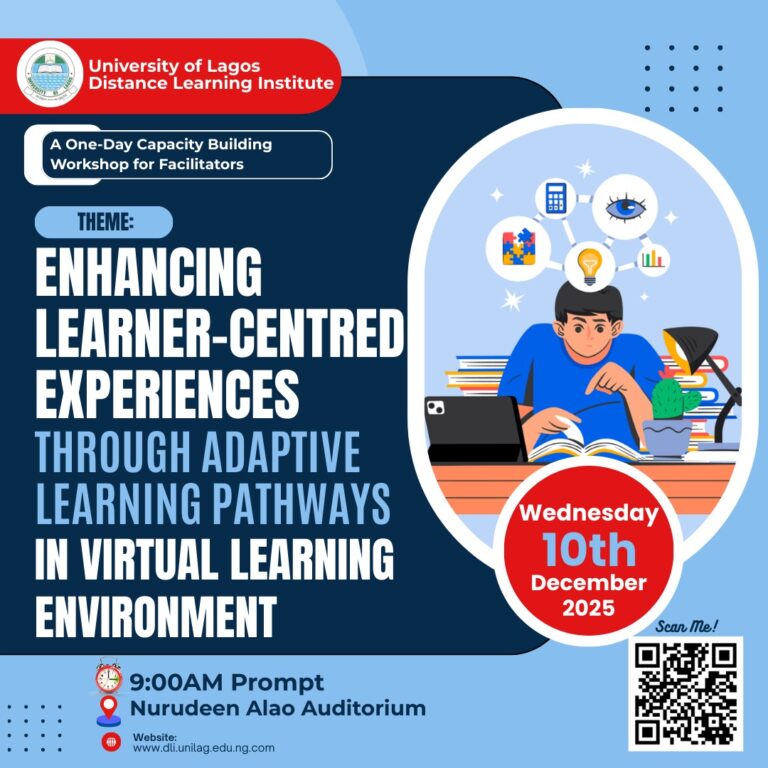
DLI is on the University of Lagos main campus at Akoka, Yaba, Lagos. Its facilities include the Nurudeen Alao Auditorium, small and large tutorial rooms, an e-resource centre, a virtual library and a video recording studio, with learning delivered online through the DLI Learning Management System.
DLI has the status of a faculty within the University and runs its programmes through three academic departments: Management Sciences (Accounting, Business Administration, Finance), Social Sciences (Economics, Public Administration) and Education (B.Sc. (Ed.), B.Ed. and B.A. (Ed.) programmes).