
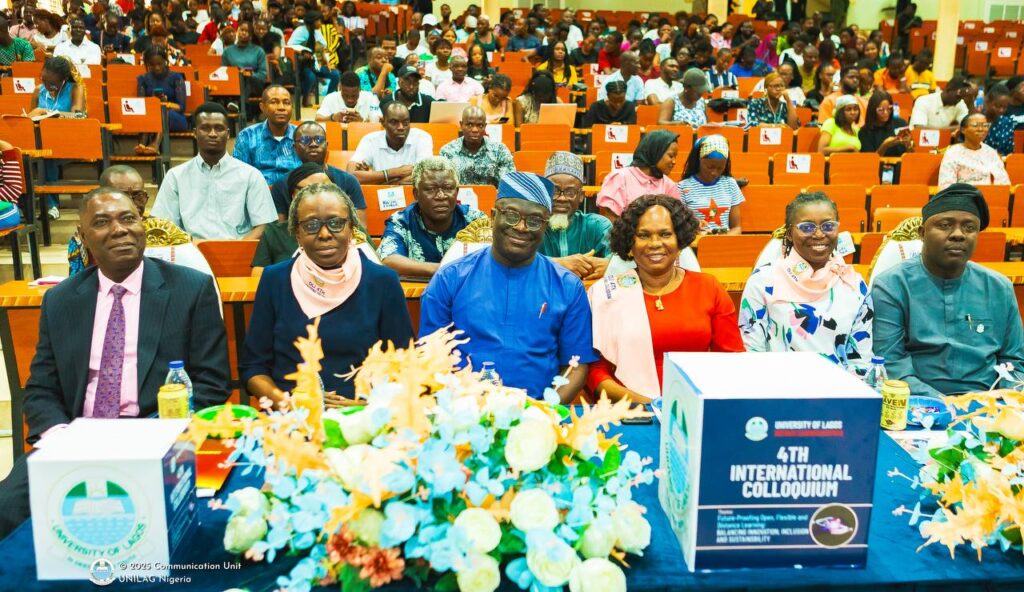
A rallying call to transform education echoed powerfully on Thursday, September 11, 2025, as stakeholders from academia, government, and industry gathered at the 4th International Colloquium of the Distance Learning Institute (DLI), University of Lagos (UNILAG).
United by a shared commitment to shaping a more inclusive, innovative, and sustainable future for learning, participants came together under the theme: Future-Proofing Open Flexible Distance Learning: Balancing Innovation, Inclusion and Sustainability.
Held at the Nurudeen Alao Auditorium, UNILAG, the colloquium served as both a strategic checkpoint and a visionary platform to explore how education can evolve in an increasingly digital and interconnected world.
Welcoming participants, the Vice-Chancellor, Professor Folasade T. Ogunsola, OON, FAS, highlighted the human dimension of digital learning, warning that while technology is the game-changer, it must not come at the cost of human connection: “Our challenge is to make distance learning more human, more connected, and more socially enriching.” She emphasised that the time had come for African science, innovation and education to claim their place on the global stage, and that OFDL must serve as a catalyst for that transformation.
In her address, the Director of the Distance Learning Institute, Professor Risikat Oladoyin Dauda, described digital education as a necessary equaliser in today’s learning landscape. She emphasised that OFDL must go beyond simply placing lectures online to offer “personalized, adaptive learning systems that serve diverse learner needs”, adding that “Technology should not alienate; it should connect. It must be tailored to our context to truly serve the people.”
According to her, future-focused OFDL should not be designed only for the wealthy and well-connected who have laptops and fast internet; it must also serve people in rural communities without electricity, who may have just a radio or a simple cell phone.
Professor Dauda, renowned as the first female Professor of Economics at the University of Lagos, proposed a collaborative charter between the Federal Ministry of Education, the Nigerian Communications Commission (NCC) and the National Information Technology Development Agency (NITDA), aimed at guaranteeing every Nigerian, regardless of location or income, access to flexible and inclusive education.
Industry Voices, Global Perspectives
The colloquium was chaired by entrepreneur and Group Managing Director of Sahara Energy, Dr. Kola Adesina, MFR, who called for a complete rethink of Nigeria’s educational model. He described inclusivity as “no longer optional,” stating that technology must be harnessed to reach those at the margins and create systems that are both scalable and equitable.
Delivering the keynote address, Dr. Nicole Lotz of The Open University, United Kingdom, emphasised the need for digital learning spaces to foster community, co-creation and emotional well-being, rather than simply deliver content, asserting that “well-being, motivation, and belonging are now as vital to academic success as any curriculum.”
Professor Chukunoye Enunuwe Ochnogor of Tshwane University of Technology spoke on the imperative to align African education with the realities of the Fourth Industrial Revolution, recommending investments in digital infrastructure, inclusive educator training and cross-sector collaboration.
The event also featured goodwill messages from Olabisi Onabanjo University, University of Ilorin, Achievers University, and the Federal University of Technology, Akure.
Deliberations and Practical Pathways
A panel session anchored by Regina Chris-Ogbodo reinforced the need to integrate cultural relevance with technological advancement. The panel included Prof. Oyesoji Aremu of Achievers University; Dr. Hadu Ligeri, who represented the Executive Secretary of the National Universities Commission; Professor Abdullah Ribadu; Professor Ganiyat Adesina Usman; and Dr. Chrissi Nerantzi, who joined virtually.
Pre-Colloquium Workshop
A pre-event workshop held on Wednesday, September 10, 2025, featured a presentation on Inclusive, Equitable and Sustainable OFDL: Strategies for a Better Future by the former Vice-Chancellor of Obafemi Awolowo University, Ile-Ife, Professor Eyitope Ogunbodede. He argued that sustainable open learning cannot rely on technology alone but must be grounded in faculty development, learner-centred support systems, strategic financing models and continuous monitoring: “If education is to remain a public good, every innovation we introduce must open doors wider not close them.”
Report: Bayo Salau
Photographs: Ayo Oloyede